
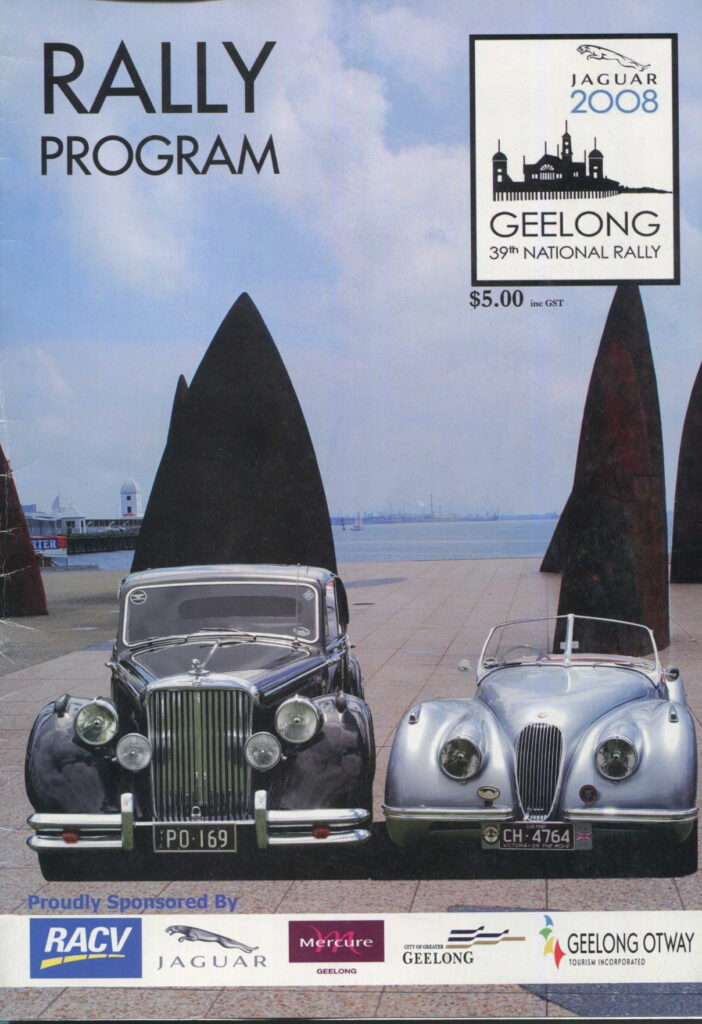
2008 marks the 60th year of the launch of the Jaguar XK-120 and the Mark V. Rather than go over old material, we have an article on David’s XK-120 Story. The first is the XK-120 of David Laird, where David gives an insight to its purchase and subsequent restoration. David also remembers the launch of the Mark V.
A Young Lad
David’s love affair with Jaguars began in 1948 when he finished at the local Tech school and was all set for an engineering apprenticeship. Six weeks before Christmas though his father found him a holiday job in the city as an office boy at Currie and Richards – plumbers supplies.
By chance this business was in Elizabeth Street opposite Brylaw Motors Jaguar dealers. After a brief interview David started the next day sweeping the footpath and occasionally looking up on the opposite curb to see a beautiful Mk IV Jaguar saloon. Brylaw Motors bought these up from the wharf before getting cleaned near the TAA office in Franklin Street and later they were outside for the new owners to collect. After looking at these vehicles David began to fall under the Jaguar influence.
The Vision
In the New Year when David took up his apprenticeship he attended classes at Collingwood Tech and RMIT. The city classes in milling and gear cutting did not start till 5.30pm so David always found time to check out the Jaguars still gleaming in the Elizabeth Street showroom. On a wet and windy night In June 1949 Brylaw Motors showroom window featured the new Mk V saloon in black with red leather upholstery.
David vowed to get one but as his apprentice earning totaled 33 shillings the 1,500 pounds for a Jaguar sale was well out of his reach. Eventually he did get a Mk V saloon but it was not until 1972 – a one owner car which has given David and his family many years of wonderful motoring. The Mk V was originally released to the public in October, 1948 at the first motor show in London after WWII.
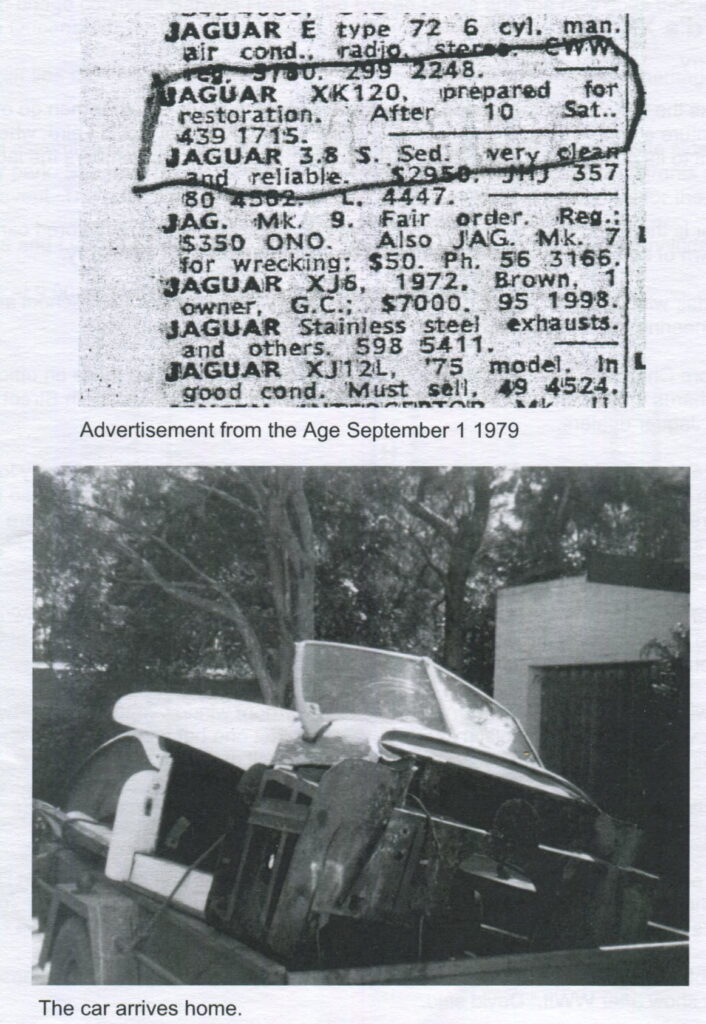
The show also saw the release of the XK 120 super sports car which was to be the test bed for Jaguar’s new twin cam motor which they were going to fit in the new Mk VII. “I yearned to obtain an XK 120 roadster as I would then have the two cars that were released at the very first motor show after WWII,” David said. It was not until September 1, 1979 and he was building a carport that he took a break to read the Age Car guide and saw under the Jaguar listing “JAG XK 120 prepared for restoration. Call after 10 a.m.”
The Opportunity
As he recognised a nearby Eltham phone number it was no trouble to wander around for a look within the hour. Much to his surprise there were two more potential buyers. “The words “preparation for restoration” have a very deep meaning when you see a complete car dismantled to the last nut and bolt,’ David said. The bare chassis still had the differential and the two back wheels fortunately. But the two front wheels were given to a friend to make a trailer.
The engine and gearbox were dismantled and parts were out behind the garage in the grass and it was long grass that hid the con rod, pistons with the rings together and the gearbox. “I expressed interest and after half an hour with the other buyers the vendor ran a mini auction between us two remaining keen bidders,” “After half an hour we got up to a figure beyond my reach so I pulled out and left it to the young chap. But I told him I wanted first option on it if he sold it later on. I said I would pay him what he paid now and any money spent with receipts plus 10%,” David said.
The young fellow put down a $5 deposit but told the vendor he would make arrangements for the full amount from parents holidaying on the Gold Coast. The owner was far from satisfied with this arrangement and asked David what sort of deposit he could produce. With two $50 notes the car was David’s. “Realising the next day was Fathers Day I had a very nice present but when would I get to drive it?”
The Challenge
David remembers. After paying the balance he collected the parts and brought around two front wheels so he could push the chassis onto the tandem trailer. “I soon realised this restoration was an enormous job and that I didn’t know much about XK 120s,” David said.
The Restoration
So David made arrangements to get a parts book and spent hours making a list of parts on hand and those that were missing. Eventually he established that he had 60-70% of the car. Missing parts included the fuel tank, hand brake lever, clutch, passenger seat, all instruments, and accessories such as side curtain frames, hood bows for the hood and the fixing screws for the side curtains to fit on the doors. The panel work was only fair and the right hand front guard had 30lbs of body filler.
Obviously, it had been raced in competition work, and after 18 months, David was in a dilemma about where to start. Eventually he found the courage to strip the chassis and completely stripped and refurbished the bushes and the front end assembly, collected all motor parts and assembled the gear box assembly; put the motor and gearbox together. By the time he joined the tail shaft he had a rolling chassis to show people that he had made some progress in five years.
The Project
David appreciated the services of a great panel beater Tom Peach who made a new right hand front guard and helped him make new door frames and skin them along with the boot lid. A left hand guard from came from Ron Whylie in Geelong and David’s old aluminum left hand guard was exchanged for the steel one he wanted. The car had been in a very bad smash and the rear left hand area needed a lot of work cutting out the old panels and putting in new ones.
The nose cone of the bonnet had to be replaced because the grille area was dilapidated and being aluminum the grille was bent. Specialty Panels refurbished a few more panels and after more panel work the car finally got painted. It was then time to start fitting up the parts and put in the wiring loom, adjust the motor and get the interior trimmed including carpets, hood and side curtains.
Slow Progress
This was a 20-year process fondly known as a “stop go” restoration mainly due to find the time while running a small business and finding the limited finance which comes with family commitments. “However, having finished it, it is wonderful to drive; it looks magnificent and drives magnificently and would surely drive as well as a new one,” David said.
David would like to thank all the members of the Jaguar Car Club of Victoria that have helped him over the 20 years of the restoration of his car. Also, my son Bruce, who photographed most of the restoration and ordered a custom Electra-loom, wiring harness with indicators, and installed it per aviation standards. “Their assistance and encouragement were wonderful,” David said.