
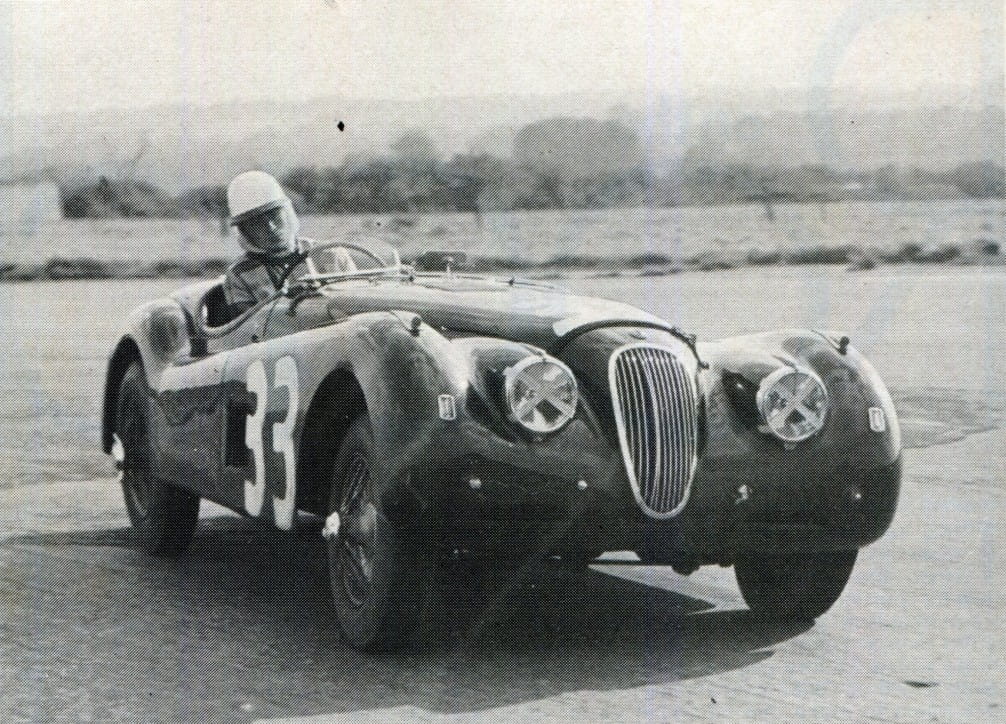
WHEN on May 30, 1949 a 3 1/2- litre British production car the XK-120, handled by a works’ driver, was officially timed at 132.6 m.p.h., the claim that the world’s fastest standard cars are made in England was reasserted with a comfortable margin in hand. The car in question, a Jaguar, later proved that it had all-round merit in addition to a virtuosity in velocity by winning the production car race at Silverstone, but, despite these performances, there may have been many who reserved their judgment until figures could be given for a car capable of running on British Pool petrol, and equipped with full-width screen and touring equipment.
We are proud that we became the first instrument whereby such impartial figures could be attained, although testing of such a car is not wholly without embarrassment, since there are few places in the world where level road speeds of the order of two miles per minute can be sustained so as to be recorded with accuracy and safety. The obvious recourse was to a closed track, but the only one available-Montlhéry-suffers from the disadvantage of banking so steep that the car in effect has its weight increased by 50 per cent. so that a test here really calls for special springs and non-standard tyre equipment.
Montlhéry, however, is highly suitable for high-speed fuel consumption trials, and by combining this circuit with the autostrad in Belgium some historic figures have been obtained and are presented in this issue. Not only was the 120 m.p.h. Mark exceeded, but in addition, it was possible to start the car in top gear, and to accelerate from rest more quickly than any other car so far tested, even including those types in which a fluid torque converter increases the performance on “direct” drive. To have achieved these results with a car offering comfortable springing, smooth and quiet running, tractability and a factory cost of under £1,000 is a signal achievement, and fully explains why this model is one of the few for which dollar buyers are prepared to wait, however impatiently.
There is, surely, a lesson here which transcends this immediate case of a high-performance two-seater. It is that the export market will respond to a car having outstanding quality in its class and sold at a reasonable price. The average car is palpably more difficult to sell and it is evident that British designers must be guided by the motto “Aim Higher” and manufacturers must remember when competing with foreign makes the advice given by an Admiral to a Junior Officer: “My boy, if argument becomes heated about politics after dinner, and someone throws a glass of wine in your face, don’t throw your wine in his; throw the decanter stopper.” In the realm of high-speed motoring, it is evident that Mr. Lyons, of Jaguar Cars, has thrown a heavy stopper very hard indeed.
