
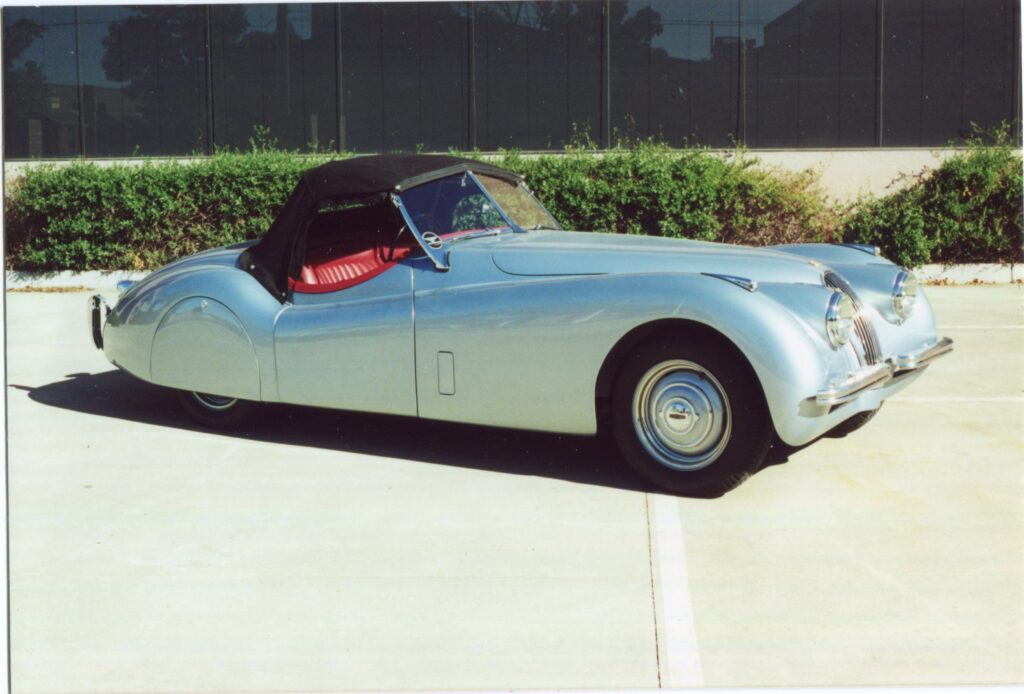
NOT many people are aware of the fact that the Jaguar XK-120 came about almost by accident rather than design. The Coventry firm had had under development for some time a new double-overhead-camshaft engine, destined for use in a new high-performance family sedan. For one reason or an- other the new engine was not ready when the Mark V car was introduced.
The Mark V carried a thoroughly redesigned chassis incorporating for the first time an independent front suspension and an extremely heavy X-member frame. But the power plant was the prewar, pushrod, 3.5-liter six. The XK 120 roadster was built up as a show car, to test pub- lic reaction. It had a shortened Mark V chassis, the new experimental engine, and striking modern lines. At the London Show, in the fall of 1948, the new roadster was an absolute sensation. American visitors and West Coast Jaguar distributor Charles H. Hornburg, Jr., in particular, were so enthusiastic that plans for the Mark VII sedan were temporarily shelved in favor of an all-out effort to produce the XK-120.
How the engine was tooled up and the first 1000 bodies were built practically by hand is another story, but even so it was nearly a year before sample cars were available in the United States for inspection. It wasn’t until 1950 that deliveries in any quantity were made. The XK-120 offered performance for a price that made all other sports cars very poor value. Here, for the first time, was a sports car that offered a genuine top speed of 120 mph, amazing flexibility and tractability, and a price below that of the cheapest Cadillac. It was, and still is, the kind of car that can be compared only to the very expensive, semicustom productions like Ferrari, Alfa Romeo, and Bugatti. Success was immediate, and in America many people waited nearly two years for delivery. Many well-known movie stars, who have owned sports cars of all types, became satisfied owners. As production got rolling, Jaguar sales in dollars earned for England exceeded that of any other imported car. The XK 120 is one of the products of Jaguar Cars, Ltd., Coventry, England, the offshoot of a firm founded in 1922 by William Lyons and a partner.
The partner, Bill Walinesley, resigned in 1936, leaving Lyons in control. The original company was called the Swallow Side Car, and Coach Building Company, and its entire energy was devoted to the production of those products. Before many years had passed, Lyons had expanded to the point where he could buy Austin chassis, equip them with special bodies, and sell them as Swallow Austins. In rapid succession there were other combinations -the Swallow Standard, Swallow Fiat, Swallow Swift, and Swallow Hornet. The next step up was a deal in 1931 with the Standard Company whereby Standard built chassis to Lyons’ measurements for a new series of cars.
These were the first SS cars, and they sold so well that in 1933 Lyons formed a new company for their production, S.S. Cars, Ltd. Between 1933 and 1939 S.S. Cars, Ltd., improved and consolidated its position, at the same time working steadily towards the goal of complete independence from major component suppliers. In 1935 the SS Jaguar, the first car to bear that feline title, was powered by an S.S.-designed 2.7-liter, ohy engine manufactured by the Standard concern in a factory set aside for that purpose. The following year came the most famous of the prewar models, the SS 100, with a 3.5- liter six-cylinder engine, also designed by the S.S. firm.
This is still a highly desirable car, and in a good state of time it will readily exceed the top speed its name promises. The Autocar clocked 101 with a completely stock example. Acceleration was brisk—0 to 70 mph in 14.7 seconds. The ear was as maneuverable as it was fast, due mostly to the short, 104-inch wheelbase. But then, as now, the foremost appeal of the Jaguar was its price-$2175 with the 3-185-ce. engine, $1925 with the smaller, 2664-cc. engine. Though the SS 100 was fast and beautiful, it did not measure up to racing standards. The simple, long-stroke, pushrod, ohv engine could not deliver the power per cubic inch necessary to keep up with available overhead-cam sports machinery, most of which cost many times more than the SS 100. S.S. Cars, Ltd., did not care at all.
William Lyons would sponsor no factory competition entries, preferring to leave this to the individual owners. There was little need to indulge in this expensive form of advertising. The SS 100 needed no sales boost, and the firm’s radically styled family cars were equally popular. After the war the company’s production was restricted to the Mark IV and Mark V passenger cars until the introduction of the XK 120. Both the Mark IV and Mark V carried modifications of the old pushrod engines, but behind the barrier re- search was being conducted on new engines. Two were planned and built-a four-cylinder of 2 liters displacement, and a six-cylinder of 3.5 liters.
The four went through one frantic run in Goldie Gardner’s car at 176 mph and then was jerked back out of sight. The six formed the basic engine for the XK 120, the XK 120M, the Mark VII sedan, and the XK 120C. In its dimensions it is surprisingly close to the prewar push- rod engines. The stroke-to-bore ratio of 1.28 is only a little less than the SS 100’s 1.34; displacement of the new engine is only fractionally less than the earlier type. The stroke of the new engine is the same as the stroke of the 2664-cc. engine that appeared in 1935. Another point of similarity is the seven-main-bearing crankshaft. Once past these points of obvious similarity, the differences assert themselves. In the top end the two engines are not remotely similar.
The XK has two overhead camshafts, hemispherical combustion chambers with the valves positioned 70 degrees apart, and centrally located spark plugs. This improved design makes it possible to peak the stock engine at 4900 rpm, a figure more commonly associated with either very small engines or pure competition machinery. Such high engine speed, particularly when achieved with a stroke of more than 4 inches, brings up the troublesome question of piston speed.
At the horsepower peak the XK engine has a piston speed of slightly over 3400 fpm. For touring this is relatively unimportant. The 3.54-to-1 top gear of the stock roadster permits a road speed of 82.8 mph at a piston speed of only 2500 fpm. At the horsepower peak the calculated road speed is 112.5 mph. In competition, however, where the engine is kept as close to the peak as is possible by the extensive use of the gears, the greater wear and higher friction of the long-stroke design must be compensated for. The competition record of the XK engine proves that the engineers have managed to do just that.
Bottom-end trouble with XK engine is unknown. Just as the new engine is a thorough redesign of the old, so the new chassis and body bear little resemblance to the SS 100. In overall dimensions, there is little difference except for the increased overhang of the modern body. The classic sports-car concept of long hood, restricted passenger space, and small trunk compartment is adhered to, and the flowing lines of the body make it quite efficient aerodynamically.
The frame is composed of traditional side rails with appropriate bracing and is a modification of the one introduced shortly after the war. Torsion-bar, independent front suspension, a postwar development first used on the Mark V, is also used on both the XK and the Mark VII. Essentially the XK is a sporting version of the Mark VII rather than a unique sign. This explains the fact that the XK is not a light car by sports-car standards.
