
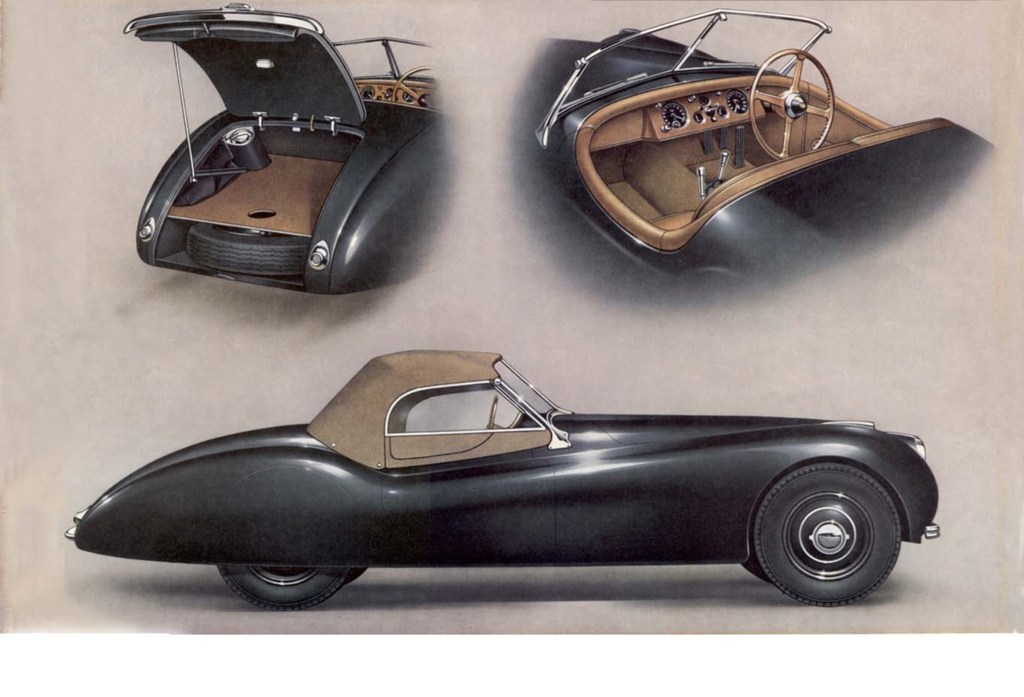
The XK-120 Development
The development of the XK-120 really started back during the late 1930’s when the then William Lyons dreamed of building a 5 passenger 100 MPH Saloon car, however, due to the outbreak of World War 2 in September 1939 his plans were shelved as the factory ceased car production and changed to the manufacture of various equipment for the war department.
To demonstrate the company’s versatility, 56 armament contracts were carried out during the war years. The first project was building flaps and various other major wing components for Stirling bombers, then the repairs to Whitley and Wellington airframes, and the manufacture of the thousands of small components for Spitfire, Lancaster, and Mosquito planes.
The XK Engine
The XK engine was designed during midnight fire watching sessions by Bill Lyons, Bill Heynes, Claude Baily and Walter Hassen the vital statistics of 3342cc, 83mm bore by 106mm stroke six cylinders in line are now legendary. This engine was unique as it was the first production unit to harness the sophistication of twin overhead camshafts in a cylinder head with hemispherical combustion chambers. This motor design went from 1948 to 1986.
The first priority when peace was finally declared was to recommence car production of the pre-war model SS saloons, meanwhile William Lyons and his team set about designing a new saloon to take the new engine. Because of all the delays in the supply of steel and pressing of new panels it was decided to update the existing SS ML IV body and use the push rod motor in the new designed chassis with the new Heynes IFS front end as production model.
After further discussion Lyons helped by the others including Lofty England made the decision to test the XK motor in a sports car using a modified new chassis by reducing the wheelbase from 10ft to 8ft 6in and 6in in the track, only 200 would be made with further small batches if the demand was there.
The superb body design was the most rapid of its type ever carried out by Sir William as he quoted because it was done more quickly than anything before or since and it was not altered from the first attempt”.
The work was carried out using aluminum, as this material besides being light and easy to work by hand, it was, after the war cheap and plentiful and not subject to rationing.
Earl’s Court 1948
It was this alloy that was adopted for making the production body shell in just six weeks for the first post-war English motor show, which was opened in London at Earl’s Court on 27th October 1948. This car on display made such an impact on the public that the number of orders placed forced Lyons to change his thinking and make arrangements with Pressed Metal of Oxford to manufacture steel pressings for the body
While the bronze XK-120 super sports open two seater (OTS), as it was officially named displayed at Earl’s Court had made such an impression on most people, some were doubtful of the car’s ability to achieve the speed implied by its name.
After all, 120 mph performance had previously only been the prerogative of the most expensive European sports or sports – racing cars usually built in small numbers and mostly supercharged, yet here Jaguar were offering a car that could attain 2 miles per minute in Standard production condition and yet only cost just under GBP 1200 including purchase tax, here they were AUD 1512 pounds plus registration etc.
Jabbeke Speed Record
In May 1949 a DC-3 flew a party of journalists to Belgium, where they witnessed for themselves a production XK-120 exceed not 120 but 130 MPH. The car at Jabbeke was HKV-500 the second LH drive built, chassis No 670002 painted white and driven by the works test driver Ron “soapy” Sutton.
He had gained confidence in both himself and the car by a series of early morning and late evening runs near Coventry; these went smoothly, and Sir William decided to initiate this demonstration.
Timing was under the control of the Belgian RAC, first Sutton drove the XK with hood and Side screens erected and recorded no less than 126.448 MPH, next the hood and side screens were removed and the windscreen was detached and a small aluminum cowl fitted and a metal tonneau cover fitted over the passenger’s seat, on these two runs the car achieved 131.916 for the North run and 133.596 for the south run, which gave a mean speed of 132.596 MPH. 670002 was later reduced to scrap in 1951.
Thus, the XK-120 earned its type designation. Other names followed:
- The Jaguar XK super sports two-seater
- The Jaguar XK 120 super sports open two-seater
- The fastest standard production sports car in the world The sports car with the racing performance